
American Innovation, Patent Ownership, and National Security
In June 2017 a bankruptcy court in Delaware sold an American battery company for $9.16 million. The technology had been built with federal money. The buyer has been reported as affiliated with a company whose plant sits in Guangdong. For the next fourteen months the public register of patent ownership said nothing had happened at all — and when it finally spoke, the new owner was carrying the seller’s name. Nothing about the sale was unlawful, no national-security notification appears to have been required, and none is publicly identifiable. That’s exactly the point. This is a paper about the category that sale belongs to: why the United States cannot reliably see it, why AI-related patenting is expanding while AI-assisted methods are making ownership reconstruction more feasible, and why the federal government has resumed taking direct equity positions in companies whose inventions it has no publicly identifiable cross-government mechanism to track.
by Parshad K. Brahmbhatt Vice President, SIM IP
Statutes, regulations, agency reports and federal award and contract records cited below were retrieved from the primary source on or before 13 August 2026; sources supporting the corrections of September 2026 were retrieved on 15 September 2026. A number of notes rest on trade press, specialist legal commentary, or third-party trackers; those are identified as such where they appear. Five statistics in wide circulation are corrected in the text and one is withdrawn as unverifiable. Claims we could not confirm are identified as such. No party named in this essay is alleged to have acted improperly. Where the text refers to designated entities it means entities the United States has itself designated, on its own published lists. The firm publishing this would seek to build the capability the essay describes, and that interest is set out at the end.
SUMMARY
The United States screens companies and transactions. It does not systematically screen changes in the ownership of patents. A patent estate can be assigned to a foreign-controlled buyer without triggering an investment review, an export licence, a secrecy determination, or a notification to any national-security body — and the public record of that transfer may be incomplete, delayed, or never created at all.
Why does this matter? Visibility: the question is not only who owns the contractor, but who owns the underlying rights after a transaction. Control: if rights move, a programme office may find it harder to shift production, maintenance or upgrades to a second supplier — practical latitude rather than legal permission, since patent ownership alone does not displace a government-purpose licence, § 1498 protection, technical-data rights already purchased, or existing contractual rights. Strategic ownership: who controls a technology bears on future systems, improvements, licensing and supply-chain resilience, and bears on each differently if the estate moves to a foreign or adversarial-controlled entity.
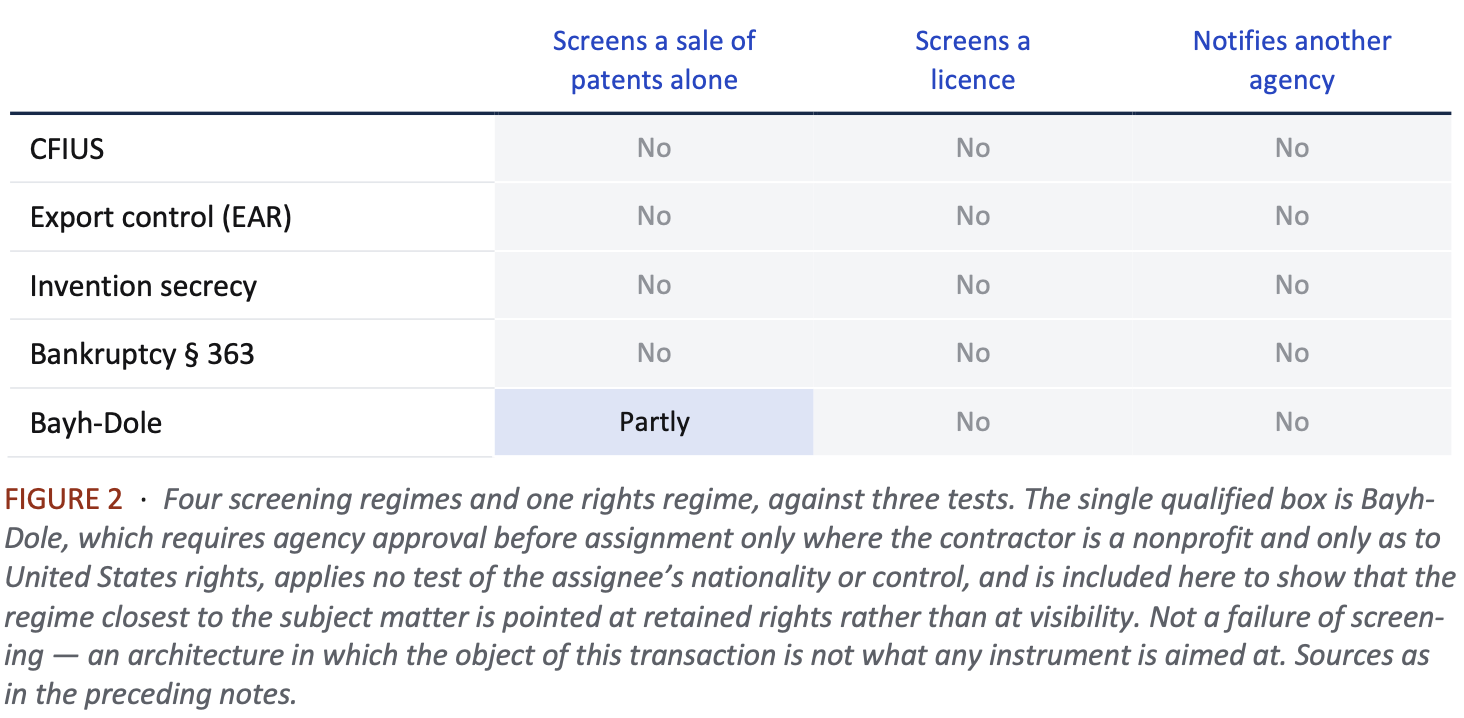
The gap is structural, not negligent. Five regimes might be expected to reach these transfers. CFIUS is keyed to control of a U.S. business. Export control expressly exempts technology disclosed in a published patent. Invention secrecy screens applications, not owners. A § 363 sale conveys assets to the best bid. And Bayh-Dole — the regime most readers reach for — requires assignment approval only from nonprofit contractors, only as to United States rights, and applies no test of the assignee’s nationality or control. Nothing failed, because nothing was aimed at the transaction.
Artificial intelligence changes the arithmetic. It is enlarging the volume of patented output, and plausibly the number of transactions in which rights move. It is changing the economics of testing validity. And it is, for the first time, making ownership reconstruction tractable at scale. The same capability that enlarges the problem makes the answer buildable.
What is missing? Not authority, and not data. The United States publishes a register of recorded changes in patent ownership and, separately, lists of the entities it has designated as controlled by or affiliated with foreign adversaries. We found no publicly identifiable government capability that joins them, reconstructs ownership through domestic entities, reads designation status as it stood at the time, and reports what moved. What is missing is the decision to look.
No party named acted improperly, and none is alleged to have. The recorded register is not complete. The answer is not a simple join of two clean federal tables. And this paper does not establish whether strategically material transfers are common, rare, or nonexistent. Nor does ownership monitoring reach licensing, standards participation, or every other form of technological leverage. It reaches the ownership-transfer blind spot, and that is all it claims.
CHAPTER I
The Auction
A federally supported battery company changed hands. Five screening regimes were pointed somewhere else, and the public record barely recorded it.
Aquion Energy began, as a good deal of American industrial technology does, inside a university. Jay Whitacre, then a professor at Carnegie Mellon, had been working since 2007 on a low-cost approach to bulk energy storage: an aqueous chemistry using sodium ions in a saltwater electrolyte, cheap and non-flammable, built from manganese oxide rather than the cobalt that makes grid-scale storage expensive and combustible. A venture he founded in 2008 licensed the core invention from Carnegie Mellon, was renamed Aquion Energy in January 2010, and spun out that year.1
The Department of Energy paid for half of one project. Award OE0000226 funded the demonstration and manufacturing scale-up of the sodium-ion system, not the company at large and not, so far as the public record shows, any identified invention: the federal share was $5,179,000 against a recipient share of $5,180,827, a total project value of $10,359,827, on the theory that grid storage was a national interest. What that award bought, and whether any patent is a subject invention under it, is a question this chapter returns to and cannot answer.2
It did not work as a business. Aquion filed for Chapter 11 protection in the District of Delaware on 8 March 2017, which is unremarkable; hardware companies fail constantly and their assets are sold to whoever will pay. What happened next is also unremarkable, and that is the argument of this essay.3
The auction was held on 20 June 2017 and the sale order entered the following day. The winning bid — for substantially all of the company’s assets, not the patents alone — was $9.16 million from an entity called Juline-Titans, LLC. That was roughly three times the stalking-horse bid. The sale closed in late July, and the press release announcing the company’s emergence from Chapter 11 was headlined “Aquion Energy, Inc. Emerges from Chapter 11 Bankruptcy Status Under New US-Based Ownership.” The buyer was described in that release as “a majority-American joint venture.”4,5
Juline-Titans has been reported by trade press as affiliated with China Titans Energy Technology Group, a company listed in Hong Kong whose manufacturing sits in Zhuhai, in Guangdong province. China Titans’ own 2025 annual report carries Aquion Energy LLC among unlisted equity interests held at fair value, as an investment rather than a consolidated subsidiary — so affiliation is documented and control is not.6
Then the patent record caught up, and when it did so is the most instructive detail in the case. Two instruments sit on the register, and each carries three separate dates that must be kept apart. The assignment from Aquion Energy, Inc. to Juline-Titans, LLC, at Reel/Frame 046849/0152, is effective 21 June 2017 — the date of the sale order — but was not executed until 30 August 2018 and not recorded until 12 September 2018. The change of name from Juline-Titans, LLC to “Aquion Energy LLC,” at Reel/Frame 047058/0785, was executed 15 August 2017, given corporate effect by a Delaware amendment filed 22 August 2017, and also not recorded until 12 September 2018. Nothing in that sequence is irregular; a nunc pro tunc recital reaching back to the closing is ordinary practice. The interval is the point. For roughly fourteen months after the sale the public register did not disclose the transfer. When the instruments appeared, they appeared together, and the assignee of record bore the seller’s name.7,8
Four locks on the wrong door — and a fifth door to a different room
This case establishes that a federally supported estate changed hands, that the public register did not disclose the transfer for fourteen months, and that when the register spoke the assignee bore the seller's name. It does not establish that any authority was evaded: the sale was of substantially all the company’s assets, not a patent portfolio in isolation, which places it closer to the regulation’s example of acquiring a whole business than to its example of a bare licence. It does not establish who ultimately controlled the buyer, which is reported by trade press and documented in no filing we could reach. And it does not establish that the patents were subject inventions at all. Aquion is the case where visibility failed. It’s not proof that no authority existed.
The structural point is more interesting than a failure. Nothing failed, because nothing was aimed at the transaction. Four screening regimes might be expected to reach a transfer of this kind. Each is keyed to something other than what moves. A fifth is keyed precisely to federally funded inventions, and is not a screen at all.
CFIUS is keyed to transactions involving a U.S. business — control transactions and also certain noncontrolling investments in businesses dealing in critical technologies, critical infrastructure or sensitive personal data — and not to the transfer of a standalone patent asset. The durable distinction is business versus asset rather than control versus no control. The regulation says so, and then illustrates it. Example 7 supposes a company that has developed important technology used in armoured personnel carriers, and a foreign party that negotiates a licence to manufacture using it: “neither the proposed acquisition of technology pursuant to that license agreement, nor the actual acquisition, is a covered control transaction.” Example 8 changes one fact — the foreign party buys the whole personnel-carrier business, “including production facilities, customer lists, technology, and staff, which together constitute a U.S. business” — and the answer flips. The perimeter is drawn around the business, and the technology is inside it only when the business comes too.9
Export control does not reach technology contained in an issued or published patent at all. The provision is titled “Patents and standards-related activity,” and it exempts technology in a patent or an open patent application available from any patent office — on the coherent logic that publication is disclosure, and one cannot control the export of what has already been told to the world.10
Invention secrecy is the genuine national-security machinery inside the patent statute, and it has operated since 1951. It screens new applications for whether publishing them would cause harm. It asks nothing about who owns a patent afterwards, and nothing about the pattern of accumulation across a portfolio. It is a censor’s instrument, not a registrar’s.11
And then there is the regime a well-informed reader reaches for first, because Aquion’s development and demonstration programme received federal funding: Bayh-Dole. It differs from the other four. It is not a screening lock and was never meant to be one. It is the regime that gives the government retained rights in inventions it paid for — and retained rights are not an observation capability. Understanding why is the most useful thing in this section.
The architecture is real. A funding recipient must disclose each subject invention to the agency, elect in writing within two years whether to keep title, and print on the face of any resulting patent that “this invention was made with government support… the government has certain rights in the invention.” The government keeps a nonexclusive, irrevocable, paid-up licence to practise the invention for or on behalf of the United States. Since 2022 the reporting runs through iEdison, operated by the National Institute of Standards and Technology.12,13 Four features of that regime decide the question, and all four cut the same way.
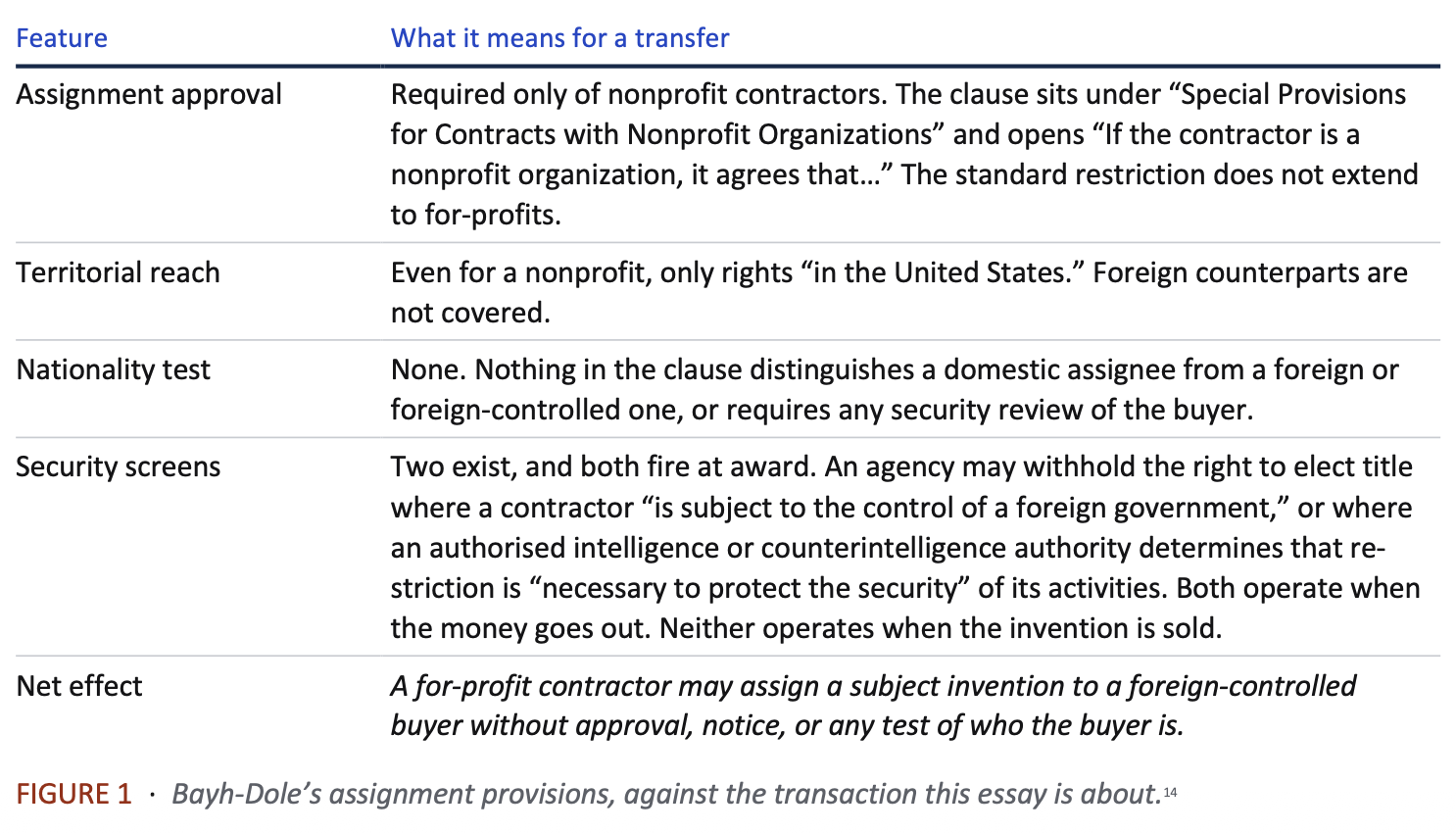
The government’s remaining levers survive the sale, and here the honest answer cuts against us. The rights follow the patent. Section 203 empowers an agency to require “the contractor, an assignee or exclusive licensee of a subject invention” to grant a licence, so a transfer does not extinguish the march-in power, and the paid-up licence survives. What is lost in the transfer is not the right. It is the sight. The right itself is close to theoretical: the four statutory grounds do not include a change of ownership or foreign control, and the Government Accountability Office reported in February 2026 that “agencies have never exer-cised marchin rights.” A draft interagency framework published for comment in December 2023 was still not final in December 2025. Section 204’s preference for United States man-ufacture binds exclusive licensing rather than assignment, tests the place of manufacture rather than ownership, and is waivable.15,16
Nor is the reporting a public record. Utilization reports are statutorily “privileged and confidential and not subject to disclosure” under the Freedom of Information Act. iEdison has no public query interface and no cross-government ownership lookup. The one genuinely public artefact of the regime is the sentence printed on the patent itself.17
So a properly reported subject invention can pass to a foreign-controlled acquirer with no generally applicable Bayh-Dole notice, no agency consent and no security review anywhere in the Bayh-Dole apparatus. The government’s licence survives the transfer, and so does its march-in power. What the regime does not supply is a general obligation to tell anyone the transfer happened. Stated precisely: neither the statute nor the standard clause imposes a generally applicable national-security approval or notification requirement when a for-profit contractor assigns a subject invention. Agency-specific award terms and iEdison’s own assignment workflows may still generate notice in particular cases. But a residual licence is not situational awareness; a power never once exercised in forty-five years is not a control; and a reporting system with no public interface and no cross-government ownership lookup is not a ledger.
And the fifth door closes on itself. Every Aquion patent and published application we examined lacks the government-support statement that § 202(c)(6) requires, and none recites the award number. The patents may have fallen outside the award; the statement may have been omitted. Either way, for an award whose dollar figures are public to the dollar, the subject-invention status of the resulting intellectual property is not publicly determinable. The one regime aimed squarely at federally funded inventions cannot be used, from the public record, to establish whether these are federally funded inventions. The essay’s thesis appears inside its own first example.18
A § 363 sale exists to convey property free and clear of interests to the best bid, quickly, for the benefit of creditors. It performs that function well. A bankruptcy judge has no national-security jurisdiction, no mandate to consider the nationality of a purchaser’s ultimate parent, and no duty to notify an agency that does.19
But patents are public — so why does ownership matter?
Every patent lawyer makes this objection, and it’s the right one. A patent is a published disclosure: the inventor tells the world how the thing works in exchange for a time-limited right to stop others using it. Nothing is hidden. So what is lost when the paper changes hands?
Secrecy was never the asset. The right to exclude was, and that is the only right a patent confers. It gives the owner no affirmative right to practise the invention: another patent, a regu-atory approval or a missing licence can still block it. What ownership materially determines is who may assert or license that right to exclude, and who receives the consideration — subject to existing licences, statutory protections, standing rules, exhaustion, validity and infringement defences, and other encumbrances. Whether a second supplier can be qualified for a programme turns on it. Where a standard is involved, so do the terms on which an entire market takes a licence. None of that changes because the technology is published. It is not the whole of the leverage in a technology. It is the part written down and transferable.
Three consequences follow that a disclosure framing misses entirely. First, enforcement leverage travels with title: an owner who wants to exclude an American manufacturer from a technology developed with American public money can do so with a patent whose contents everybody has been able to read for a decade. Second, the public now has a balance-sheet interest: the federal government holds equity in dozens of companies whose value depends in part on patent positions it has no mechanism to watch. Third, licensing terms are strategy: whether a rights-holder licenses openly, selectively, or not at all shapes which countries’ industries can build a class of product — a choice made by the owner and nobody else.
Neither of the two transactions examined here is a documented adversary case. In Aquion the buyer’s ultimate control is reported by trade press and not established from any filing we could reach. A123 is the reverse: thoroughly documented, and cleared. Neither case demonstrates a harmful acquisition. They demonstrate the narrower problem this essay claims — that the public record cannot reliably identify or classify the transfer.
The modern rules would not have caught this either. Mandatory declarations for certain critical-technology transactions took effect on 10 November 2018 and do not apply where the transaction closed before that date. Whether any CFIUS review of the Aquion sale occurred we cannot establish: the Committee publishes no transaction-level data, and no source we reached addresses it. No review has been publicly reported, and the 2018 rules could not have applied.20
The harder case, in which the review worked
If Aquion were the whole story it would be a story about bankruptcy law. The instructive case is one where the system did what its defenders describe.
A123 Systems had been awarded $249.1 million under a Recovery Act programme for electric-drive vehicle battery manufacturing, and drew somewhat over $130 million before failing. When Wanxiang acquired its non-government business, CFIUS clearance was announced on 29 January 2013, the day the sale closed. The review was real. The government business, including the United States military contracts, had already been carved out and sold to Navitas Systems, an Illinois company. By the standards of the process this is a success and should be read as one.21,22
Then look at the patent register. On 18 June 2013 the patents were assigned to an entity named Wanxiang Clean Energy USA Acquisition LLC, and on the same day a change of name to “A123 Systems LLC” was recorded. That Delaware company remains the assignee of record on patents granted as recently as September 2023.23
Which is why the obvious response — count the patents going to foreign assignees — does not work. The counting is easy. It is wrong by construction. In both cases the assignee of record is a domestic legal person: in one a foreign acquisition plainly occurred, in the other a full review took place. Any analysis resting on assignee nationality will undercount, and will undercount hardest where someone took care over structure.
An ally that reaches the asset itself
None of this is inevitable. In 2022 the United Kingdom stopped a transaction of this type with a power the United States does not have.
This is the clean example Aquion is not. No company changed hands. No title moved. What was proposed was a licence, and a licence was enough to trigger the statute.
The technology was SCAMP, a family of in-pixel vision-sensor arrays developed at the University of Manchester. As reported by its developers, the fifth-generation device puts 65,536 processor cores into a 256-by-256 pixel array, runs at more than 500 billion operations per second below 1.2 watts at peak, and has been demonstrated at frame rates up to 100,000 per second. The proposed transaction was a licence — not a sale of a company, not even a sale of the patents — to Beijing Infinite Vision Technology Company Ltd.24
On 20 July 2022 the Secretary of State made a final order under § 26 of the National Security and Investment Act 2021 concerning “intellectual property relating to SCAMP-5 and SCAMP7 vision sensing technology.” The order, in its own words, “has the effect of preventing the acquisition of the intellectual property from proceeding.” It was varied on 9 January 2023 to clarify the University’s obligations to its employees and to permit sharing in defined circumstances — and the variation notice states that the order “retains its original effect of preventing the acquisition of the intellectual property from proceeding.” The reasoning is worth quoting in full, because it is exactly the reasoning no American instrument is set up to perform: the technology “has dual-use applications,” there is “potential that the technology could be used to build defence or technological capabilities which may present national security risk,” and — the operative sentence — “those risks would arise on the transfer of the intellectual property to the Acquirer."25,26
Two features of the British statute made that possible and neither exists in American law. The Act’s definition of a qualifying asset reaches “ideas, information or techniques which have industrial, commercial or other economic value,” with trade secrets, databases, source code, algorithms, formulae, designs and specifications given as examples — intellec-tual property is the object of the regime rather than an incidental passenger. And control of an asset is defined to include acquiring “a right or interest in, or in relation to, the asset” such that the acquirer can use it, or use it more than before, or direct how it is used. A licence is caught through that language. In the United States a licence is not an acquisition of control, so for these purposes it is not a transaction at all.27,28
And the machinery is not reserved for blocking. On 5 August 2026 a further order came into force concerning the acquisition of “patent applications and associated know-how for intellectual property related to atom-beam lithography for use in advanced chip manufacturing processes” from the University of Birmingham by Lace Lithography AS, a Norwegian company. The acquisition was approved, subject to conditions requiring the acquirer to meet notification requirements in exercising rights under the licence agreement. That is arguably the more telling case of the two: a routine transaction with a friendly counterparty, and the state nonetheless has a mechanism that sees it, prices the risk and attaches a condition.29
CHAPTER II
Machine Scale
Three point seven million filings a year, and a patent office that has made machine-assisted inventions easier to obtain.
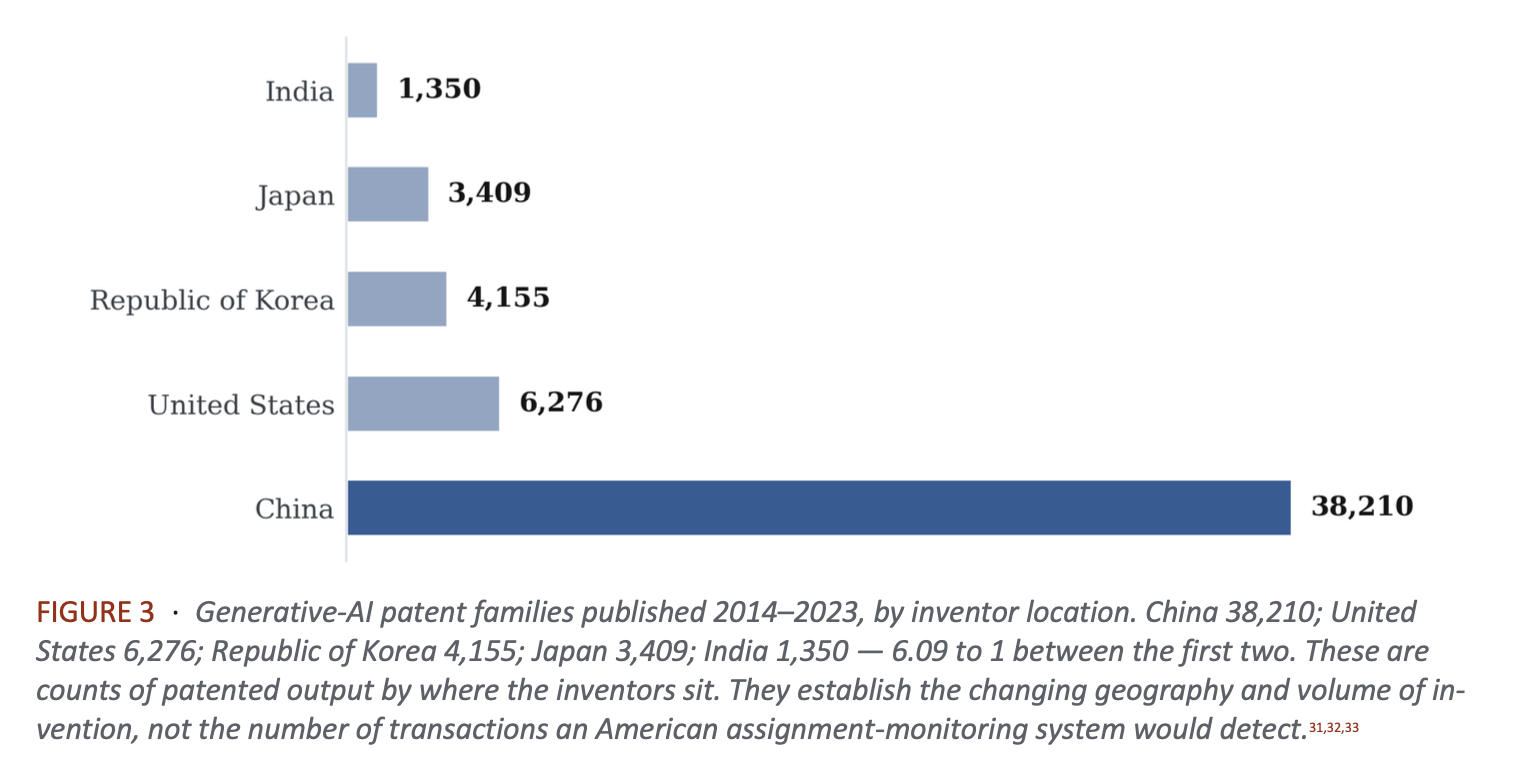
Everything above was as true in 1997 as in 2017. What has changed is volume. More patented output plausibly means more transactions in which rights move; that is a scale hypothesis, not a measured fact, and nothing later in this essay rests on its magnitude. Machine assistance is also changing the economics of testing whether a right is any good, and — the reason a remedy is buildable now and was not in 1997 — it is making ownership reconstruction tractable at a scale that was previously out of reach. The world filed 3.7 million patent applications in 2024, up 4.9%: the fastest growth since 2018 and the fifth consecutive year of expansion. Grants passed 2.1 million. China’s national office received 1.8 million applications and issued more than a million patents; the United States Patent and Trademark Office received 603,194 and granted 319,815.30
Narrow the lens to generative artificial intelligence and the picture is not competition but relocation.
A gate that opened as the volume rose
The American patent office is not idle: its unexamined backlog fell from a peak of 837,928 applications in January 2025 to 776,995 by April 2026, even as total pendency lengthened from 26.2 months a year earlier to 29.2. An institution clearing its oldest inventory while intake accelerates produces exactly that pattern.34
The conventional account holds that machine-assisted invention is straining American patent law: that subject-matter eligibility under § 101 and the law of inventorship are buckling under machines that invent. Two developments in 2025 point the other way. Neither lowered the requirements for patentability; each removed a particular source of friction.
On 28 November 2025 the USPTO rescinded its February 2024 guidance on inventorship in AI-assisted inventions and replaced it. Machines still cannot be named as inventors; only natural persons can. But the Pannu joint-inventorship factors no longer apply to AI-assisted inventions, on the reasoning that an artificial-intelligence system is not a person and so cannot be a joint inventor at all — meaning that where a single person invents with machine assistance, the ordinary standard of conception governs.35
And on 26 September 2025 an Appeals Review Panel — comprising the Director, the Acting Commissioner for Patents and a Vice Chief Administrative Patent Judge — decided Ex parte Desjardins and vacated a § 101 rejection of machine-learning claims. The claims recited mathematical operations, but the panel held them integrated into a practical application: adjusting model parameters to optimise performance on a second task while protecting performance on the first, an improvement in the functioning of a computer. Eligibility memoranda followed in December 2025 and the Manual of Patent Examining Procedure was revised to fold the decision in.36,37
An enforcement system that changed shape
A patent’s strategic weight is a function of two things: who holds it, and whether it would survive being tested. The second variable moved sharply in eighteen months, and it decides which transfers are worth watching. A capability that flags every recorded assignment is useless; one that flags transfers of estates likely to survive a challenge is a triage function. That is why the next three pages belong in an essay about ownership.
If obtaining rights became easier, testing them became something stranger. Inter partes review — the administrative validity proceeding created in 2012 — had an institution rate of 60.0% in October 2024. In October 2025 the Director assumed personal control of institution decisions and denied 34 of 34 petitions by summary order, in two tranches on 31 October and 6 November. Monthly rates fell to 20.4% in August 2025, among the lowest the series records, before recovering to 50.0% by June 2026.38
Petitioners did not stop testing patents. They changed instruments.

The fee structure explains it. An inter partes review costs a petitioner $23,750 to request and $28,125 on institution. A streamlined ex parte reexamination costs $6,775, carries no standing requirement and creates no estoppel.40
The consequence is structural rather than moral. Validity contests increasingly turn on each side’s cost of evaluation rather than the strength of the underlying position, which favours whoever can assess an asset most cheaply — sophisticated owners and sophisticated implementers alike.
Why machine-scale diligence disfavours the weak asset
Here the essay departs from the received account.
An AI-native diligence process does not begin by building a case. It begins by trying to break one. The first pass over a candidate portfolio is a disqualifier pass: prior art reading on the claims, file-wrapper estoppel, chain-of-title defects, construction exposure, eligibility fragility. The economics invert a law firm’s. Refusal is almost free and takes days; the expensive work begins only once an asset has survived.
A process whose cheapest operation is refusal is structurally hostile to weak-asset assertion, because that model depends on the cost of evaluation exceeding the cost of nuisance. Drive the cost of evaluation toward zero and the weak asset has nowhere to hide. Which reframes what the volume numbers demand: China’s office received 1,828,054 patent applications in 2024 against 603,194 at the USPTO — at either figure, no quantity of additional head-count closes the distance, and the variable that matters is rigour per analyst rather than headcount.41
CHAPTER III
The Ledger Nobody Keeps
The government has resumed buying equity in American technology companies, and wrote itself the power to take patents as part of the return. It has used the equity limb repeatedly. We found no disclosed instance of the intellectual property limb.
While the patent system was repricing itself, the United States government started buying companies.
Since January 2025 the federal government has taken equity and equity-like positions in 37 transactions with a disclosed value of approximately $27.6 billion, on the most complete public accounting available. It is a floor rather than a total: that tally was last updated on 30 July 2026 and does not absorb a further package of eight companies announced on 7 August.42,43
The transactions are neither small nor uniform. Commerce converted $8.9 billion of CHIPS funding into 433.3 million Intel shares at $20.47 — 9.9% of the company — with a five-year warrant over a further 5%, exercisable only if Intel ceases to own a majority of its foundry business. The Department of Defense took $400 million of MP Materials convertible preferred at a $30.03 conversion price, with a warrant at the same strike, a ten-year floor price of $110 per kilogram on neodymium-praseodymium oxide, and a ten-year offtake of an entire magnet facility’s output. Commerce signed letters of intent with nine quantum-computing companies for roughly $2.01 billion, each conditioned on a minority equity stake. The Director of the National Economic Council described the Intel position as “like a down payment on a sovereign wealth fund, which many countries have."44,45,46,47
One sentence, in a solicitation, that nobody has acted on
As a condition of receiving an award, applicants may be required to issue to the Department equity, warrants, licenses to intellectual property, royalties or revenue sharing, or other such instruments…
— Commerce CHIPS Research and Development Office, Broad Agency Announcement 2025-NIST-CHIPS-CRDO-01, 24 September 202548
Read that with the first two chapters in mind. The United States government has written itself the power to take intellectual property — licences, royalties, revenue shares — as its return on investment in the American technology base. The authority is operative rather than proposed, and the government’s own auditor described it in August 2026 as a live condition of award.
It has not been used. Across every transaction we could examine — Intel, MP Materials, Trilogy Metals, Lithium Americas, USA Rare Earth, Vulcan Elements, ReElement, Westing-house, all nine quantum letters of intent, the seven CHIPS letters of July 2026 and the entire package of 7 August 2026 — every disclosed instrument is common stock, preferred, convertible preferred, a warrant, a joint-venture interest, a participation in cash distributions, a loan or an offtake. Not one is over a patent, a licence or a royalty stream, and the instrument taxonomy published by the tracker that follows these transactions most closely contains no category for intellectual property at all.49
Nor is there a consolidated ledger. Neither Treasury nor Commerce publishes a portfolio of these positions; percentages are frequently undisclosed; and the analyst who maintains the leading public tracker describes assembling it as “a little bit like investigative work.” The Government Accountability Office documented the equity conditions attached to CHIPS research awards in August 2026 and made three recommendations, none of which concerned the equity terms.50
One distinction the vendor-lock literature blurs. A patent, a technical data package, know-how, a trade secret, a licence and a procurement data right are six different things governed by different law. GAO’s sustainment findings concern technical data rights acquired under defence procurement regulation: what the government bought the right to see and use when it signed the contract. This essay is about patent ownership, irrespective of what the contract said. They are legally distinct problems producing the same operational symptom, which is why the evidence below illuminates the stakes without being evidence of the gap itself.
The cost of not owning that layer is already measurable, and the clearest evidence has nothing to do with anyone abroad. In September 2025 the Government Accountability Office examined data rights across five major sustainment programmes — the F/A-18, the F-35, the Littoral Combat Ship, the Stryker combat vehicle and the Virginia-class submarine — and concluded that all five “experienced vendor lock when it came to maintenance activities.” In one instance the Army established a technical support contract with the prime contractor for the Stryker base vehicle on a sole-source basis at a cost of about $534 million over five years. Operating and support costs run to roughly 70% of a weapon system’s total lifecycle cost, and the rights position fixed at contract award determines who may compete for that 70% two decades later.51,52
One boundary belongs here, because it disposes of the loudest objection. Under 28 U.S.C. § 1498, where a contractor practises a patented invention for the Government with its authorisation or consent, the owner’s remedy is compensation from the United States in the Court of Federal Claims. No injunction issues. A foreign patent holder cannot enjoin American procurement, and this essay does not suggest otherwise. But § 1498 is a shield around federal procurement, not around the industrial base. It says nothing about the commercial supply chain a programme depends on, nothing about qualifying a second supplier, nothing about standards-essential licensing in allied markets, and nothing about the value of the equity the public now holds. It confers no visibility at all.53
A divergence, not an absence
It would be convenient to write that no state screens patent transfers and America should be first. That is false, and the accurate version can be tested.
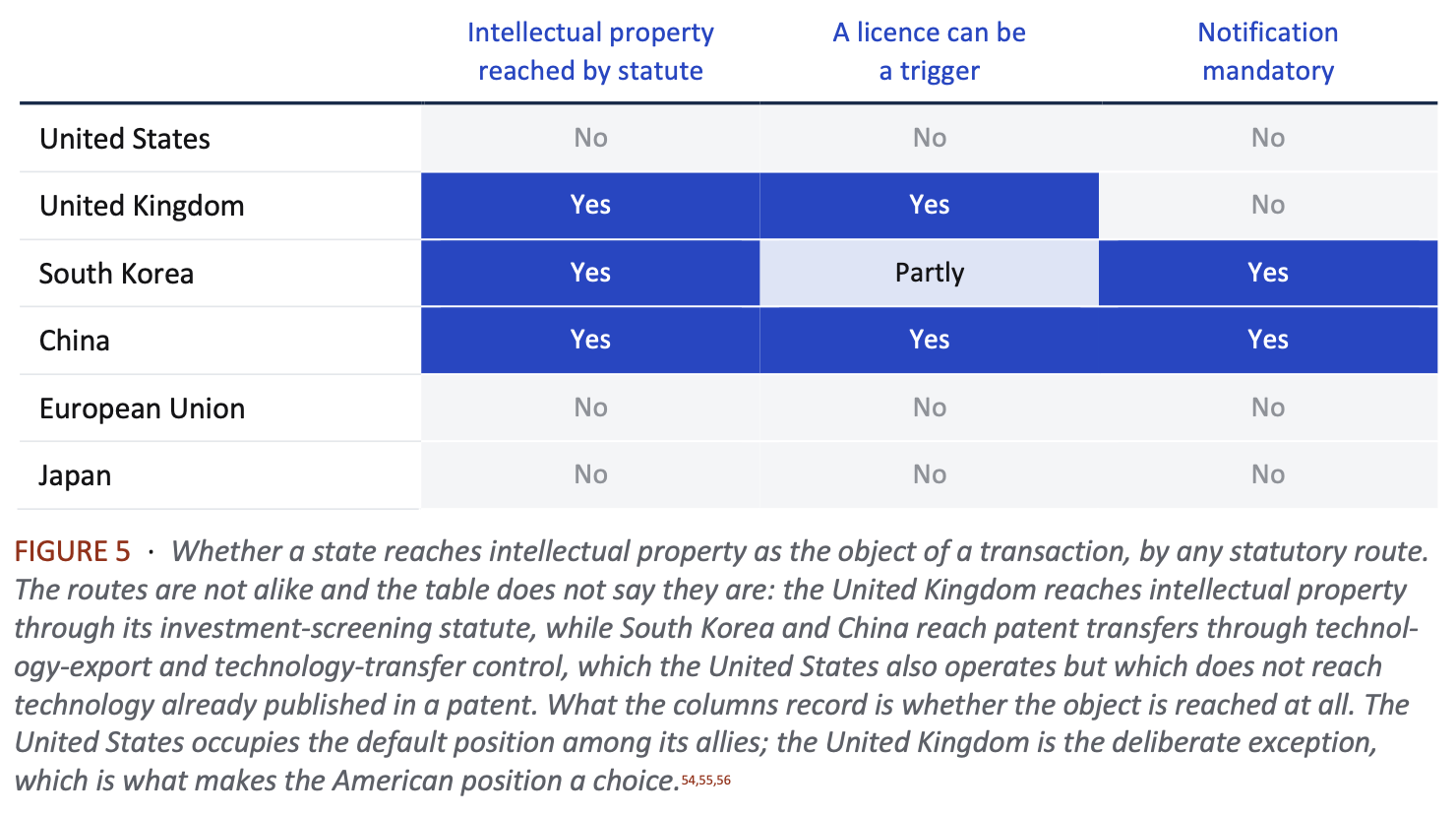
The British model also has a limit that matters more than the precedent does. Mandatory notification under the UK Act reaches entities, not assets: the Government’s guidance states that the requirements “do not apply to the acquisition of qualifying assets.” The Act’s power to change that, at § 6(6), has never been exercised. Reaching intellectual property in a statutory definition is necessary and not sufficient: without a filing trigger, a regime catches only what the state already happens to see. Which returns the problem to observation rather than to law.57
One further narrative deserves correcting, because it is repeated often and is out of date. The alarming version holds that Chinese state patent funds are accumulating Western intellectual property as an instrument of policy. The state funds of 2014 to 2016 were largely absorbed or wound down. The centre of gravity today is elsewhere and it is commercial: corporate accumulation of standards-essential patents, and courts in several jurisdictions — including China — setting worldwide licensing rates. On the leading commercial count, Chinese ultimate owners hold roughly 40.8% of declared 5G standards-essential patent families — a figure that is methodology-dependent, as all SEP shares are, and which we cite as a vendor estimate rather than as an agreed number. If that is where the contest actually sits, a response aimed at institutions that no longer operate will miss it.58
And anyone proposing that a state build capacity here owes the reader the case where it was tried and failed. France Brevets was the closest analogue a Western democracy has attempted: €105 million of capital from the French State and the Caisse des Dépôts, against which it accumulated €92.9 million of cumulative losses. In October 2022 the Cour des comptes recommended the dissolution of a company it found had not proven its usefulness; the company’s own chief executive, not the Cour, attributed the failure partly to public-sector linkage. The lesson is not that the function is impossible. It is that a state-linked vehicle carries a documented failure mode, and anyone who does not design against it has not read the file.59
Coda: The Join
What is missing is not authority, or data, or money.
The United States maintains a public register of recorded changes in patent ownership, including the country given in each assignee’s recorded address. It holds roughly 10.5 million transactions since 1970, each carrying the country given in the assignee’s recorded address — which is a field as filed, not a verified beneficial domicile. The United States separately maintains three public lists of entities it has designated as controlled by or affiliated with foreign adversaries.60
We found no agency-published join of the two.
The honest description makes the problem harder and the argument stronger. Recordation is not compulsory and it is not adjudicated. The statute directs the Office to record documents “upon request.” The Office does not check the chain of title before recording — asked directly whether title searches are conducted before recordation, it answers “No.” And the effect of recording is expressly not a determination: “The recording of a document is not a determination by the Office of the validity of the document or the effect that document has on the title."61,62
The only sanction for not recording is a private one: an unrecorded assignment is void against a later good-faith purchaser unless recorded within three months or before that purchase. There is no fine, no invalidation, and no public-interest consequence. There is no generally applicable public-law duty to record and no penalty for not doing so. Owners record for reasons of their own — to perfect priority, to establish standing before suing, to satisfy a counterparty in a transaction, to keep prosecution clean — but none of those is a public obligation, and none of them runs on the government’s timetable. The Aquion transfer makes the point concretely: a sale that closed in July 2017 produced instruments executed in August 2017 and August 2018 and recorded in September 2018, the assignment reaching back nunc pro tunc to the sale order. Every step was regular. The register was simply four-teen months behind the world.63
This bounds what can honestly be promised. The task is not joining two clean federal tables. It’s reconstructing beneficial ownership from records that are voluntary, often late, never adjudicated — and, in the cases that matter most filed by entities carrying the seller’s name. For recorded transfers the answer is computable, with stated methods and stated confidence. Anything more categorical is a promise the data cannot keep.
We built one half of it while writing this essay. The three designation lists were parsed from the issuing agencies’ own machine-readable files and reconciled into a single register: sixty-eight entities from the Treasury list, eighty designated companies and a hundred and seven named subsidiaries from the Defense Department’s, eleven named entities from the Commission’s. Two hundred and sixty-six rows. It took a day and cost nothing, because every input is public.64
Three things fell out of it before a single patent record was touched.
The first is that the same company sits on two federal lists under two different names. The Treasury list designates Zhonghang Electronic Measuring Instruments Company Limited, added in June 2021 and still current. The Defense Department designates AVIC Chengdu Aircraft Co., Ltd., and its notice says in terms that this entity was formerly Zhonghang Electronic Measuring Instruments Company Limited. Anyone screening patent assignments against the Treasury list alone will miss every record filed under the newer name; anyone screening against the Defense list alone will miss every record filed under the older one. The same notice records Phoenix Optics Company Limited becoming Phenix Optical Company Limited — one letter, and a word reordered.65
The second is that the three regimes are not synchronised and neither is a subset of another. Twenty-nine of the sixty-eight entities on the Treasury list have no counterpart on the Defense Department’s, by name or by any alias either list declares. Designation also runs backwards: the June 2026 notice removed ten companies from the Defense list, one of which — Costar Group Co., Ltd. — remains on Treasury’s. Is this counterparty designated? turns out to have no single answer.
The third is that the work is not clerical. Parsing the Defense Department’s notice by its own document markup yields seventy-nine designated companies. That is the wrong number: one designee’s heading is not tagged like the others. Parsing by document structure recovers that company and fragments two more. Neither method is correct alone. Ordinary name-matching is worse than useless here, because Chinese state enterprise names are so alike: a similarity score high enough to accept in most contexts pairs China Aerospace Science and Technology Corporation with China Aerospace Science and Industry Corporation — two different companies, two different estates. The tradecraft is the product.
So: how many United States patents changed recorded ownership last year into entities the United States has already designated? For recorded transfers, that answer is bounded and computable from existing data. Ultimate ownership remains an inference carrying a stated confidence. Both halves matter. The first is why the work is possible. The second is why it is tradecraft rather than a query. We found no published answer. The obvious method would not produce a good one. A direct-name join undercounts aliases, subsidiaries, delayed recordations and unrecorded transfers. Fuzzy matching produces false positives. The errors run in both directions, which is why the method matters as much as the data.
Congress has noticed the shape of the problem. The Senate’s fiscal 2027 defence authorisation bill would require, by 1 March 2027, an office within the Office of the Assistant Secretary of Defense for Industrial Base Policy to map capital flows through the defence industrial base and to establish pathways for contractor disclosure of subtier sourcing and beneficial-ownership data, working through the Office of Strategic Capital. The requirement is being written. No publicly identifiable capability to satisfy it exists, in government or in the vendor base.66
What such a count would have to settle first
Three definitions decide the answer. A count that has not fixed them in advance will fix them unconsciously, in whatever way flatters its own output.
A name change is not a transfer. Qualifying title events are assignments of the whole or a partial interest and transfers by merger or operation of law. Name changes and corrective instruments are identity events: they update the alias graph but do not enter the transfer count. Security interests, releases and licences are reported separately. A lien is not a conveyance, and treating it as one is the quickest way to manufacture a frightening number.
Recordation is an observation date, not necessarily the operative one. The observation date is the date of recordation, because that is when the instrument becomes visible in the public register. Execution and recited effective dates are retained as separate fields, and the lag among them is reported rather than resolved away. Aquion is the reason: three dates spanning close to fifteen months, any of which could be defended as the date of transfer. Monitoring as of recordation and retrospective characterisation as of an execution or effective date are different exercises. They should not be blended.
Designation status has to be read at the relevant date. Entities are added to the federal lists and removed from them. A present-day list applied to a decade of records would clear transfers into entities designated at the time and flag transfers into entities designated only afterwards. The snapshots are part of the work, not a refinement of it.
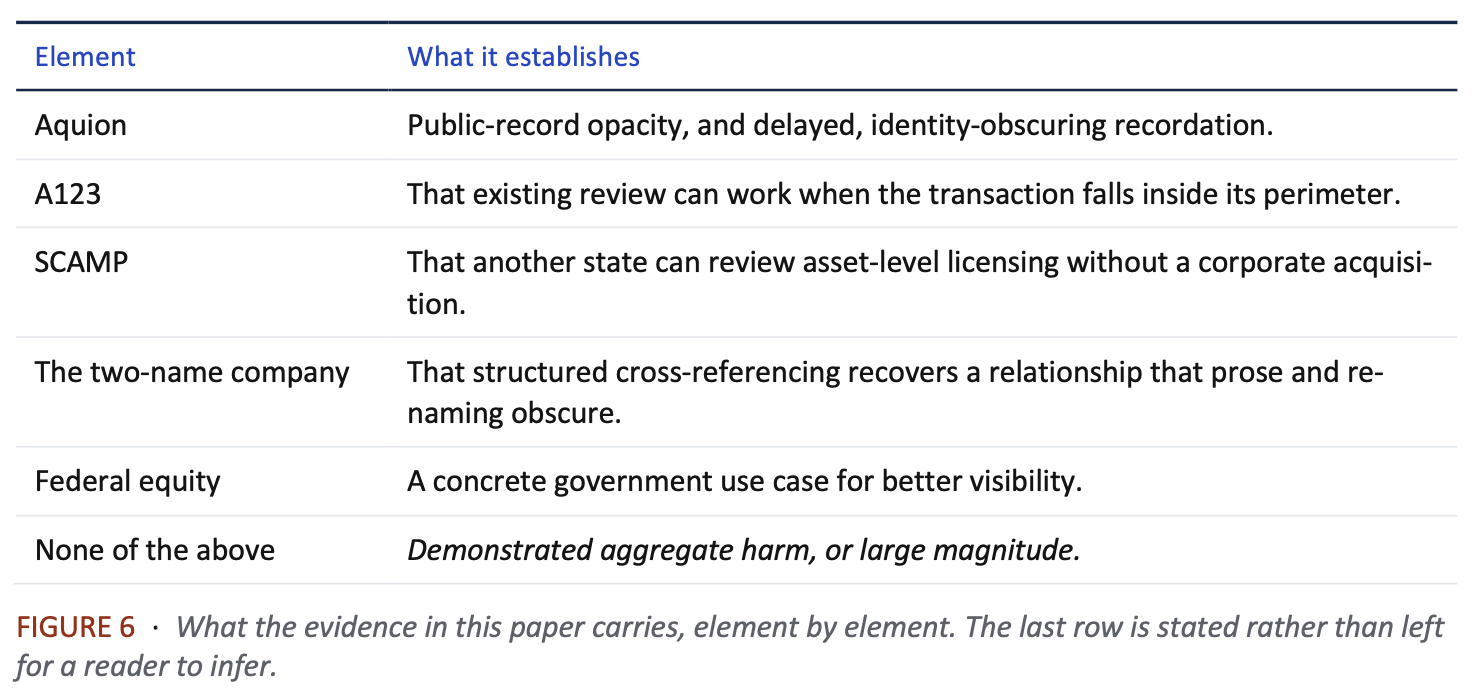
This paper does not establish whether strategically material transfers are common, rare, or nonexistent in the recorded data. We cannot demonstrate aggregate harm, because the event has never been measured, and we do not ask the reader to assume it is large. A small or zero result would be a substantive finding, and evidence against building a larger apparatus.
Nor does the assignment register carry the whole problem. It is the most standardised public event stream available for observing changes in patent title, which is the reason to start there. It does not reveal private licences, patent-pool participation, standards commitments, contractual control, trade secrets or most encumbrances. What it can measure is recorded ownership movement. Anyone who claims that this maps national intellectual-property leverage as a whole is overreaching, and that includes us.
The register exists. The lists exist. The tooling to resolve ownership at machine scale exists and is improving faster than the problem is growing. The government already has enough public data to establish a baseline, and what that baseline showed would tell it which further data and which legal mechanisms are actually required — a question that cannot honestly be answered beforehand. What is missing is the decision to measure, and then the harder decision about what, if anything, the measurement warrants. Both are American decisions. Neither has been made.
Interests
SIM IP is a patent acquisition and licensing firm and would seek to build the capability this essay describes. A reader is entitled to weigh that.
The firm holds more than 3,000 patent assets across eleven portfolios, screens candidates across 128 technology fields, and moves from patent list to closed transaction in forty-five days. In February 2026 it acquired outright the applied-artificial-intelligence platform it had judged best of four it had used. Those figures are the firm’s own record: true to the documents we hold, and not independently audited.67
It operates internationally. Its founder has had a presence in Shanghai since 2004. We regard that as relevant in both directions. Attribution work is hard to do well from outside the markets one is describing, and cross-border relationships are a matter a government counterparty is right to examine. Any mandate of this kind should be governed by written structural separation rather than by assurances.
Notes
Retrieved on or before 13 August 2026, or on 15 September 2026 where a note was corrected. Source labels are shortened; each is a live link to the address consulted. An address is given only where the source was actually reached; where a primary text was consulted but no stable public address obtained, the note says so rather than substituting a secondary one. Pending legislation, unposted funding notices and tracker figures should be rechecked before being relied upon.
1. Carnegie Mellon University faculty biography of Jay F. Whitacre; Aquion Energy company history. The company’s own term for the chemistry was Aqueous Hybrid Ion; the Department of Energy described it as sodium-ion. engineering.cmu.edu/whitacre-jay.html
2. Department of Energy, Office of Electricity fact sheet for award OE0000226, October 2015, giving all three figures and describing the scope as demonstration and scale-up; independently confirmed against the federal award record (FAIN DEOE0000226). The award is to a project. Nothing in the fact sheet identifies a patent or application as arising from it. energy.gov/OE0000226_Aquion_FactSheet_Oct_2015.pdf
3. In re Aquion Energy, Inc., Bankr. D. Del. No. 17-10500, filed 8 March 2017 before Judge Kevin J. Carey. The debtor was subsequently renamed AEI Winddown, Inc. Case details from the Troubled Company Reporter of 3 July 2017 and the case page of debtor’s counsel; the PACER docket itself was not reachable. pszjlaw.com/aquion-energy
4. Troubled Company Reporter, 3 July 2017 (auction of “substantially all of its assets” on 20 June, sale or-der 21 June, bid “approximately three times higher than the stalking horse bid”); Pittsburgh Post-Gazette, 21 June 2017. post-gazette.com/201706210147
5. “Aquion Energy, Inc. Emerges from Chapter 11 Bankruptcy Status Under New US-Based Ownership,” PR Newswire, 21 July 2017. prnewswire.com/aquion-energy-inc-emerges-from-chapter-11-bankrup…
6. pv magazine USA, 26 July 2017, describing Juline-Titans as a subsidiary of China Titans Energy Technology Group; MIT Technology Review, 8 August 2017, describing the entities as “closely affiliated.” China Titans Energy Technology Group Co., Limited is listed on The Stock Exchange of Hong Kong under stock code 2188; its filings refer to a plant in Zhuhai, Guangdong. A search of HKEXnews and of two China Titans fil-ings found no mention of Aquion or Juline-Titans. pv-magazine-usa.com/china-titans-swoops-up-aquion-for-9-2-million
7. Assignment, Reel/Frame 046849/0152: “NUNC PRO TUNC ASSIGNMENT;ASSIGNOR:AQUION ENERGY, INC.,” assignee Juline-Titans, LLC. Effective 21 June 2017, executed 30 August 2018, recorded 12 September 2018. Each instrument runs against the same nineteen properties, patents and published applica-tions together, including US 8,298,701 B2 and US 8,945,751 B2. Effective, execution and recordation dates are given separately throughout because the register carries them separately, and conflating them is how this case is usually got wrong: an earlier draft of this paper reported the execution dates as effective dates. assignmentcenter.uspto.gov/patent/46849/152
8. Change of name, Reel/Frame 047058/0785: “CHANGE OF NAME;ASSIGNOR:JULINE-TITANS LLC,” assignee Aquion Energy LLC. Executed 15 August 2017, recorded 12 September 2018. The Delaware amendment of 22 August 2017 is from the corporate filing. assignmentcenter.uspto.gov/patent/47058/785
9. 31 C.F.R. § 800.302(c) and the examples at § 800.302(f)(7) and (f)(8). Note the regulation’s term of art is “covered control transaction.” ecfr.gov/section-800.302
10. 15 C.F.R. § 734.10(a). ecfr.gov/section-734.10
11. 35 U.S.C. §§ 181–188, “Secrecy of Certain Inventions and Filing Applications in Foreign Country.” law.cornell.edu/part-II/chapter-17
12. 35 U.S.C. § 202(c)(1), (2) and (6); 37 C.F.R. § 401.14(c)(1) (two months), (c)(2) (two years), (f)(4) (the wording of the statement) and (b) (the government licence). ecfr.gov/section-401.14
13. Responsibility for iEdison transferred from the National Institutes of Health to NIST, the new system going live on 9 August 2022. nist.gov/nist-launches-new-iedison-system-reporting-federa…
14. 37 C.F.R. § 401.14(k)(1); statutory parallel at 35 U.S.C. § 202(c)(7)(A). The for-profit extension of Bayh-Dole treatment derives from Executive Order 12591, reflected at § 401.14(a)(8). The security screens are at 37 C.F.R. § 401.3(a)(1) and (a)(3). law.cornell.edu/text/35/202
15. GAO-26-107885, Intellectual Property: Information on Draft Guidance to Assert Government Rights Based on Price, 18 February 2026, at 7-9. gao.gov/gao-26-107885
16. 35 U.S.C. § 203; 35 U.S.C. § 204; the draft framework at 88 Fed. Reg. 85593 (8 December 2023). law.cornell.edu/text/35/204
17. 35 U.S.C. § 202(c)(5) and § 205; 37 C.F.R. § 401.13. NIST’s own guidance states that utilization infor-mation is treated as privileged and confidential and is not subject to FOIA disclosure. nist.gov/iedison-frequently-asked-questions-faqs
18. We examined nine Aquion Energy patents and published applications, including US 8,137,830; US 8,298,701; US 8,580,422; US 8,652,672; US 8,945,751; US 9,088,046 (originally assigned to Carnegie Mellon University); US 9,728,775; US 9,960,397; and US 2012/0270102. None carries a statement re-garding federally sponsored research. Department of Energy advance, identified and class patent waiver indexes were searched without result; DOE’s own final technical report for the award contains no subject-invention statement. Absence of a published waiver is meaningful but not conclusive; the subject-invention status of these patents is not established either way. energy.gov/patent-waivers-overview
19. 11 U.S.C. § 363, and in particular § 363(f) on sales free and clear of interests. us-code.house.gov/view.xhtml
20. Determination and Temporary Provisions Pertaining to a Pilot Program To Review Certain Transactions Involving Foreign Persons and Critical Technologies, 83 Fed. Reg. (11 October 2018), effective 10 Novem-ber 2018, and inapplicable where the completion date preceded the effective date. federalregis-ter.gov/determination-and-temporary-provisions-pertaining…
21. Department of Energy, Recovery Act awards for the Electric Drive Vehicle Battery and Component Manufacturing Initiative ($249.1 million to A123Systems); statement of Senator Charles E. Grassley, 29 January 2013, referring to “over $130 million in taxpayer funds” actually received. energy.gov/battery-and-electric-drive-awardee-list-american-…
22. “A123 Systems LLC Completes Acquisition of Substantially All Non-Government Business Assets of A123 Systems, Inc.,” 29 January 2013, recording CFIUS approval; “Navitas Systems LLC Completes the Acquisi-tion of A123 Systems’ Government Business,” 30 January 2013. CFIUS does not publish clearance dates, so the date given is the date of announcement. globenewswire.com/A123-Systems-LLC-Completes-Acquisition-of-Substan…
23. Recorded legal events for US 8,963,500 B2, showing the bankruptcy order recorded 17 June 2013 and the assignment and change of name both recorded 18 June 2013; US 11,769,882 B2, “Multi-layered coated electrode for lithium-ion battery,” granted 26 September 2023, assignee A123 Systems, LLC. pa-tents.google.com/US11769882B2/en
24. Specifications published by the SCAMP vision-chip research group. The figures given are for SCAMP-5; the group publishes no equivalent specification for SCAMP-7. scamp-vision-chip.org/technology
25. Notice of final order, acquisition of know-how related to SCAMP-5 and SCAMP-7 vision sensing technol-ogy, 20 July 2022. assets.publishing.service.gov.uk/aquisition-scamp5-scamp7-know-how-final-order-not…
26. Notice of variation of final order, 9 January 2023. assets.publishing.service.gov.uk/aquisition-scamp5-scamp7-know-how-notice-of-varia…
27. National Security and Investment Act 2021, s.7(4)(c) and s.7(5). legislation.gov.uk/25/section/7
28. National Security and Investment Act 2021, s.9, headed “Control of assets.” The section does not use the word “licence”; a licence is reached through the “right or interest in, or in relation to” formulation. legisla-tion.gov.uk/25/section/9
29. Notice of final order, acquisition of patent applications and associated know-how related to atom-beam lithography, in force 5 August 2026. The order records the transaction as a trigger event under s.9(1)(b) and approves it subject to notification conditions. gov.uk/acquisition-of-patent-applications-and-associated…
30. World Intellectual Property Organization, World Intellectual Property Indicators 2025, covering calendar year 2024. wipo.int/patents-highlights.html
31. WIPO, Patent Landscape Report: Generative Artificial Intelligence (Geneva: WIPO, 2024), Figure 17a and Table 6. Figures are simple patent families counted by inventor location, keyed to publication year over 2014–2023; because a family with inventors in several countries is counted once per location, the country columns exceed the world total. The set is defined by a fine-tuned classifier with stated precision 0.80, recall 0.90 and F1 0.85, so there is a measurement band around every value. Dataset total 54,358 families. wipo.int/en
32. A caution about a figure that circulates loosely: the widely quoted “more than 14,000” is the 2023 annual figure, not a cumulative total, and should not be compared with the ten-year counts above.
33. These figures have since been superseded in part. WIPO’s SPARK: Patent Trends Update in GenAI of 14 July 2026 reports China publishing over 43,000 families in 2024–2025 alone, the United States rising to over 4,380 in 2025, and Japan overtaking the Republic of Korea for third place. The update publishes pe-riod counts on a different basis from the cumulative figures above and does not print values for Korea or India, so the two cannot be combined; the ranking in this figure is accordingly stated as of the 2024 report and is now stale as to third place. wipo.int/en
34. USPTO Patents Data at a Glance, figures as of April 2026 and February 2026 respectively. uspto.gov/dashboard/patents
35. Revised Inventorship Guidance for AI-Assisted Inventions, 90 Fed. Reg. 54636 (28 November 2025), superseding the guidance of February 2024. federalregister.gov/revised-inventorship-guidance-for-ai-assisted-inv…
36. Ex parte Desjardins, Appeal 2024-000567, Appeals Review Panel decision of 26 September 2025. uspto.gov/202400567-arp-rehearing-decision-20250926.pdf
37. USPTO subject-matter-eligibility memoranda of December 2025 and consequent revisions to MPEP §§ 2106.04(d), 2106.04(d)(1), 2106.05(a) and 2106.05(f). fr.com/uspto-adds-desjardins-to-mpep-subject-matter-elig…
38. USPTO Patent Trial and Appeal Board trial statistics; Patently-O, “An Era of No: The USPTO’s New 0% Insti-tution Rate,” 12 November 2025; IPWatchdog analysis of USPTO institution data, 8 April 2026; Unified Patents and Harness IP post-grant survey for the second quarter of 2026. A caution for anyone quoting a single figure: the USPTO’s fiscal-2026 year-to-date rate is 39% by petition — 343 institutions against 531 denials — and the office reports discretionary and merits determinations separately. Any institution rate should be stated with its basis. The office publishes no monthly institution-rate series; monthly figures here are derived by differencing successive year-to-date releases, which the office restates from time to time. patentlyo.com/usptos-institution-rate.html
39. USPTO post-grant filing data as compiled in Patently-O, “Decimation: Ex Parte Reexamination Eclipses the IPR,” 2 May 2026, and the Unified Patents post-grant survey for the second quarter of 2026. patent-lyo.com/decimation-ex-parte-reexamination-eclipses-the-ip…
40. USPTO fee schedule effective 19 January 2025. America Invents Act trial fees rose 25% under the fiscal-2025 fee-setting rule. A figure of roughly $4,800 circulates in commentary as the cost of opening a sec-ond front; no fee in either the current or the prior schedule corresponds to it. uspto.gov/uspto-fee-schedule
41. World Intellectual Property Organization, World Intellectual Property Indicators 2025: CNIPA received 1,828,054 patent applications in 2024 (1,672,001 resident, 156,053 non-resident) and the USPTO 603,194 (270,295 resident, 332,899 non-resident); both are applications received by the office in calen-dar year 2024, invention patents only, utility models reported separately. An earlier draft attributed the 1.8 million figure to a single unnamed office in a way that implied the USPTO; it is China’s office, and the attribution is corrected here. For comparison on a different basis, the USPTO reports 475,223 serialized patent filings in fiscal 2025. wipo.int/wipo-pub-941-17-2025-en-world-intellectual-proper…
42. Council on Foreign Relations, U.S. Government Deal Tracker, maintained by Jonathan E. Hillman, last up-dated 30 July 2026. Fortune publishes a lower count of $26.7 billion across 30 transactions and defers to the CFR tally as the most complete public accounting; neither publisher’s agency sub-counts sum to its own stated total. cfr.org/washingtons-growing-portfolio-tracking-u-s-govern…
43. “Fact Sheet: President Donald J. Trump Announces Billions in New Deals and Investments to Power American Mining,” The White House, 7 August 2026. whitehouse.gov/fact-sheet-president-donald-j-trump-announces-bil…
44. Intel Corporation, “Intel and Trump Administration Reach Historic Agreement,” 22 August 2025. news-room.intel.com/intel-and-trump-administration-reach-historic-agr…
45. MP Materials, “MP Materials Announces Transformational Public-Private Partnership with the Depart-ment of Defense,” 10 July 2025. mpmaterials.com/mp-materials-announces-transformational-public-pr…
46. National Institute of Standards and Technology, “Department of Commerce Announces Letters of Intent with 9 Companies, $2 Billion,” 21 May 2026. nist.gov/department-commerce-announces-letters-intent-9-co…
47. Kevin Hassett, Director of the National Economic Council, as quoted in Fortune, 26 July 2026. Executive Order 14196 of 3 February 2025 directed the Secretaries of the Treasury and Commerce to deliver a sov-ereign-wealth-fund plan within ninety days; no fund exists and we located no published plan. for-tune.com/the-u-s-government-invested-27-billion-in-corpora…
48. Broad Agency Announcement 2025-NIST-CHIPS-CRDO-01, 24 September 2025. The Government Ac-countability Office paraphrased the provision in GAO-26-109121, “Semiconductors: Commerce Needs Plan to Meet CHIPS for America R&D Requirements,” 6 August 2026, as a condition under which compa-nies “may be required to provide a return on investment to the government”; it does not reproduce the solicitation’s own sentence. nist.gov/CRDO%20BAA_final.pdf
49. Our own search of agency releases, company disclosures and Securities and Exchange Commission filings for each named transaction, conducted 12 August 2026, together with the CFR tracker’s published meth-odology and instrument categories. This is a searched null rather than a claim of comprehensiveness: six-teen CHIPS letters of intent had not reached definitive documentation at that date, and definitive docu-ments are where such a term would appear. cfr.org/how-the-government-invests-insights-from-cfrs-u-s…
50. Marketplace interview with Jonathan E. Hillman, 4 August 2026; GAO-26-109121, 6 August 2026, whose three recommendations concern planning for the National Semiconductor Technology Center, the Ad-vanced Packaging Manufacturing Program and the Industrial Advisory Committee. files.gao.gov/GAO-26-109121/index.html
51. GAO-25-107468, “Weapon System Sustainment: DOD Can Improve Planning and Management of Data Rights,” September 2025 (reissued with revisions 29 September 2025), from which the vendor-lock finding and the Stryker figure are taken verbatim. gao.gov/gao-25-107468
52. GAO-26-108140, “Weapon System Sustainment: DOD Identified Critical Cost Growth, and the Army Should Take Action to Yield Cost Savings,” 23 April 2026: “Operating and support (O&S) costs historically account for approximately 70 percent of a weapon system’s total life-cycle cost.” We note for complete-ness that two contractor quotations of $990 million and $2 billion for technical data packages, which circulate in commentary and which we had previously relied upon, do not appear in GAO-25-107468 and could not be verified; they are accordingly withdrawn. gao.gov/gao-26-108140
53. 28 U.S.C. § 1498(a). Because the remedy is compensatory and the Court of Federal Claims’ jurisdiction is limited to money judgments under 28 U.S.C. § 1491(a), injunctive relief is unavailable; and because no statute affirmatively grants a jury in such an action, none is available — Lehman v. Nakshian, 453 U.S. 156 (1981). law.cornell.edu/text/28/1498
54. Republic of Korea, Act on Prevention of Divulgence and Protection of Industrial Technology, Art. 11(1): where a holder of a national core technology “developed with government subsidies for research and development” intends to export it to a foreign corporation “by means of sale, transfer, etc.,” it “shall obtain approval from the Minister of Trade, Industry and Energy.” The Korean row is marked Partly on the licence column for that reason: approval is required where the technology was government-funded, while Art. 11-2 requires advance approval for cross-border acquisitions, mergers and joint ventures involving govern-ment-funded national core technology, and an advance report for the rest. Cited from the English translation published by the Center for Security and Emerging Technology (translation by Etcetera Language Group, 7 March 2023; enforcement date 4 April 2023); the authoritative text is the Korean. cset.georgetown.edu/t0521_industry_protection_EN.pdf
55. Regulations of the People’s Republic of China on the Administration of Import and Export of Technolo-gies. Two provisions carry the Chinese row, and a definitional article alone would not. Art. 2 lists “assignment of the patent right, assignment of the patent application right, licensing for patent exploitation” among the acts constituting technology import and export. Art. 39 then provides that “freely exportable technology shall be subject to the contract registration administration,” while making clear that registration is not a condition of the contract’s validity; Art. 40 requires registration with the competent foreign trade department under the State Council, with the application, a copy of the contract and proof of the parties’ legal status; Art. 41 gives that department three working days to register; and Art. 42 makes the registration certificate the instrument used for foreign-exchange, banking, taxation and customs formalities. Restricted technology travels a separate licensing track. In force 1 January 2002 (Art. 55). Text as published by the intellectual-property portal of the Ministry of Commerce. ipr.mofcom.gov.cn/trade/jsjcktl.pdf
56. Regulation (EU) 2026/1386 of 17 June 2026, in which intellectual property appears at recital 48 as a risk factor rather than a trigger, and which applies only from 17 January 2028, Regulation (EU) 2019/452 remaining in force meanwhile; amendments to Japan’s Foreign Exchange and Foreign Trade Act of May 2026, which added indirect acquisitions and nothing on intellectual property. We did not retrieve a stable public text for the Korean Enforcement Decree, and the count of designated national core technologies given in an earlier draft is withdrawn as unverified.
57. United Kingdom Government, “National Security and Investment Act: guidance on acquisitions.” The power to make asset acquisitions notifiable is at s.6(6) and has not been exercised. gov.uk/guidance/national-security-and-investment-act-guidance-on-acquisitions
58. Patently Ltd, The world’s leading 5G patent owners 2025, attributing 40.8% of all 5G-declared SEP families to Chinese ultimate owners against a base of over 87,000 published declared families as at December 2024; a commercial estimate, cited as one. For the jurisprudence, and not for any share figure, see Kirti Gupta and Mark Cohen, “The New SEP Powerhouse: How China is Shaping Global Patent Disputes,” Center for Strategic and International Studies, 7 May 2025. csis.org/new-sep-powerhouse-how-china-shaping-global-paten…
59. Coverage of the Cour des comptes findings on France Brevets, December 2022; French Senate written answer detailing the capital contributions. senat.fr/qSEQ221204490.html
60. USPTO Office of the Chief Economist, Patent Assignment Dataset, data through 2023; the Office of Foreign Assets Control Non-SDN Chinese Military-Industrial Complex Companies List; the list maintained under § 1260H of the FY2021 National Defense Authorization Act; the Federal Communications Commis-sion Covered List. These are the government’s own designations and are cited as such.
61. 35 U.S.C. § 261, as reproduced at MPEP § 301; 37 C.F.R. § 3.54 as set out at MPEP § 317.03; USPTO frequently asked questions on assignments. uspto.gov/mpep/s317.html
62. USPTO assignment FAQ: “Are title searches conducted by the PTO prior to recordation? No. All documents that meet the minimum requirement in 37 CFR 3 are processed and recorded.” uspto.gov/assignments.jsp
63. 35 U.S.C. § 261, final paragraph; MPEP § 317.03. uspto.gov/mpep/s301.html
64. Office of Foreign Assets Control, Non-SDN Chinese Military-Industrial Complex Companies List, 16 De-cember 2021; Department of Defense, Notice of Availability of Designation of Chinese Military Compa-nies, 91 Fed. Reg. 35189 (10 June 2026); Federal Communications Commission Covered List as published, stated updated 3 September 2024, eleven rows. The Commission added foreign-produced un-crewed aircraft systems and their critical components by public notice DA 25-1086 of 22 December 2025, which the published list does not yet reflect. The register and the code that produced it are availa-ble on request. federalregister.gov/notice-of-availability-of-designation-of-chinese-…
65. The renames are declared in the designation notice itself, at 91 Fed. Reg. 35189. We note them as a data-reconciliation problem, not as an allegation about any company.
66. S. 4784, 119th Congress, § 842, as reported in the Senate. Pending legislative text, which may be amended or dropped; cited as evidence of where the demand is being written rather than as law.
67. SIM IP acquisition-process documentation, July 2026, and a published interview with the firm’s chief executive, 6 August 2026; first-party figures, available for substantiation on request. The founder’s twenty-year record precedes the firm, which was founded in 2024, and is stated separately for that reason.
